.gif)


%20(1)%201.png)
CBN's AML Deadline Is Here: How to Prepare Before June 2026

When Nigeria exited the FATF grey list in October 2025, it was a defining moment for the country's financial system. Years of regulatory reform, institutional coordination and political will had finally paid off. But that exit was never meant to be a finish line. It was a starting point.
The CBN's March 2026 circular has made that unmistakably clear. Every regulated financial institution in Nigeria, from deposit money banks to mobile money operators to payment service providers, must now deploy automated AML solutions that meet new CBN AML requirements 2026. And the first critical deadline is already around the corner: implementation roadmaps must be submitted to the CBN's Compliance Department by June 10, 2026.
For compliance leaders who have spent years navigating manual processes, fragmented systems and growing regulatory expectations, this circular changes the game. It is the most consequential financial crime compliance directive Nigeria has seen in years, and it demands a level of technological readiness that most institutions have not yet achieved.
What Has the CBN Mandated and Who Does It Apply To?
The CBN's March 2026 circular (referenced as BSD/DIR/PUB/LAB/019/002), establishes mandatory CBN baseline standards for AML across the entire regulated financial sector. These standards apply to all financial institutions currently operating under CBN regulation; furthermore, applicants for new licenses must also demonstrate compliance or present a credible implementation plan as part of the authorization process.
The circular introduces three compliance milestones that every institution needs to plan around:
The implementation roadmap is more than a plan; it is a formal regulatory submission that demands absolute precision. To satisfy this requirement, the document must include:
- A current-state assessment and gap analysis to pinpoint specific vulnerabilities.
- The proposed AML solution architecture.
- A phased timeline featuring named milestones and clear owners for every workstream.
- A robust governance and oversight framework.
- A committed resource and budget plan.
This submission requires the highest level of internal accountability, finalized with the signatures of both the CEO and the Chief Compliance Officer.
The CBN is clear that compliance is not a checkbox exercise. The regulator will evaluate demonstrable effectiveness rather than vendor-driven implementation. In practice, simply having a system in place is no longer the benchmark. The regulator now requires proof that the solution delivers measurable results in:
- Detecting complex financial crime patterns.
- Facilitating thorough investigations.
- Maintaining precise, timely reporting.

The 12 Baseline Capabilities That Will Define CBN Compliance 2026
The circular sets out 12 capability areas that every automated AML solution must support. For institutions still relying on manual processes or disconnected point solutions, this list serves as the definitive benchmark against which the CBN will measure readiness.
One requirement in the circular is worth highlighting separately. The CBN has explicitly stated that AML solutions operating solely on transaction data, without effective linkage to customer identity, risk profiles and case histories, will not be considered compliant. Institutions rated High or Above Average risk within their subsector are specifically required to ensure full integration between their AML systems and their KYC/KYB repositories. This effectively ends the era of siloed compliance architecture in Nigeria's financial sector.
Get Your Free Guide
A complete, easy-to-use guide for your gap analysis
Why Is This Circular Different from Previous Nigeria AML Regulations?
Nigerian financial institutions have seen plenty of regulatory updates over the years. So what makes this one stand out?
- Accountability now sits at the top
Compliance is no longer just an institutional responsibility. The circular makes it clear that board members, CEOs, and Chief Compliance Officers can be held personally accountable. A compliance failure is now a direct leadership risk.
- Explainable AI is a regulatory requirement
The CBN has formally introduced AI and machine learning governance into its AML framework. Institutions must deploy automated AML systems, with expectations scaled to their size and risk profile.- Larger institutions are expected to use advanced AI-driven systems
- Smaller institutions can adopt proportionate solutions, but must still meet baseline requirements
- Strict AI governance expectations apply
Any use of AI or ML must include:- Human oversight
- Algorithm transparency and explainability
- Clear reasoning behind every alert generated
- Independent validation at least annually, covering accuracy, drift, fairness, and bias
- FATF Compliance depends on execution
Nigeria’s exit from the FATF grey list was a major milestone. This circular is about sustaining that progress. The CBN is signalling that compliance must be continuous, measurable, and evolving to maintain global credibility.
What Is Actually Holding Institutions Back?
The directive is clear and well-structured. But across the sector, readiness remains a significant concern. What are compliance teams actually up against?
The fraud numbers reinforce the urgency. Nigerian banks lost ₦3.3 billion to fraud in the first quarter of 2025 alone, a 137% increase from ₦1.39 billion in the previous quarter. For institutions still managing financial crime compliance Nigeria requirements through manual and fragmented setups, the risk of falling behind is not theoretical.
Disconnected systems are still common. Identity verification and AML processes often run on separate platforms with limited data sharing. The CBN requires integration across AML systems, core banking, and KYC or KYB data to enable a unified customer view.
The CBN also encourages a unified financial crime setup where AML and fraud systems share risk signals. This means many institutions must rethink how their systems connect and operate.
Too many tools, not enough integration. Nigeria’s RegTech market has expanded, but many solutions are single-purpose. Institutions need to assess vendors based on API capabilities, integration depth, and their ability to support end-to-end compliance needs.
A Step-by-Step CBN Compliance Roadmap to Get Ready Before June 2026
With the June 10 deadline approaching, institutions need a structured approach that meets CBN expectations and supports long-term compliance.
Start with a clear gap analysis. Map your current capabilities against the 12 baseline areas in the circular. Identify what is compliant, where gaps exist, and where systems are misaligned. This forms the foundation for all next steps.
Evaluate system integration. Does your AML case management system connect to your KYC records and customer risk profiles? Does your transaction monitoring engine assess activity within the context of the full customer profile, or does it operate on raw transaction data alone? The CBN has stated clearly that the latter approach is not acceptable.
Prioritise near real-time screening and monitoring. This includes sanctions screening, PEP checks with fuzzy matching, suspicious activity detection across channels, and the ability to block onboarding or transactions instantly when needed. Batch processing is no longer sufficient.
Prepare a Board-authorised implementation roadmap. This must be submitted to the CBN Compliance Department by June 10. Include your gap analysis, solution architecture, phased timeline, governance framework, and sign-off from the CEO and Chief Compliance Officer.
Embed AI governance early. If using AI or ML for risk scoring or detection, document validation processes, explainability standards, and bias testing. The CBN expects outputs that investigators can clearly interpret.
Focus on continuous compliance. The CBN will monitor through ongoing reviews and examinations. Institutions that build for transparency, governance, and continuous improvement will be better positioned than those treating this as a one-time task.
Building Compliance Infrastructure That Outlasts the Deadline
The institutions that will emerge strongest from this transition are those that see the CBN's March 2026 circular not as a regulatory burden but as a catalyst to build compliance infrastructure that delivers lasting value.
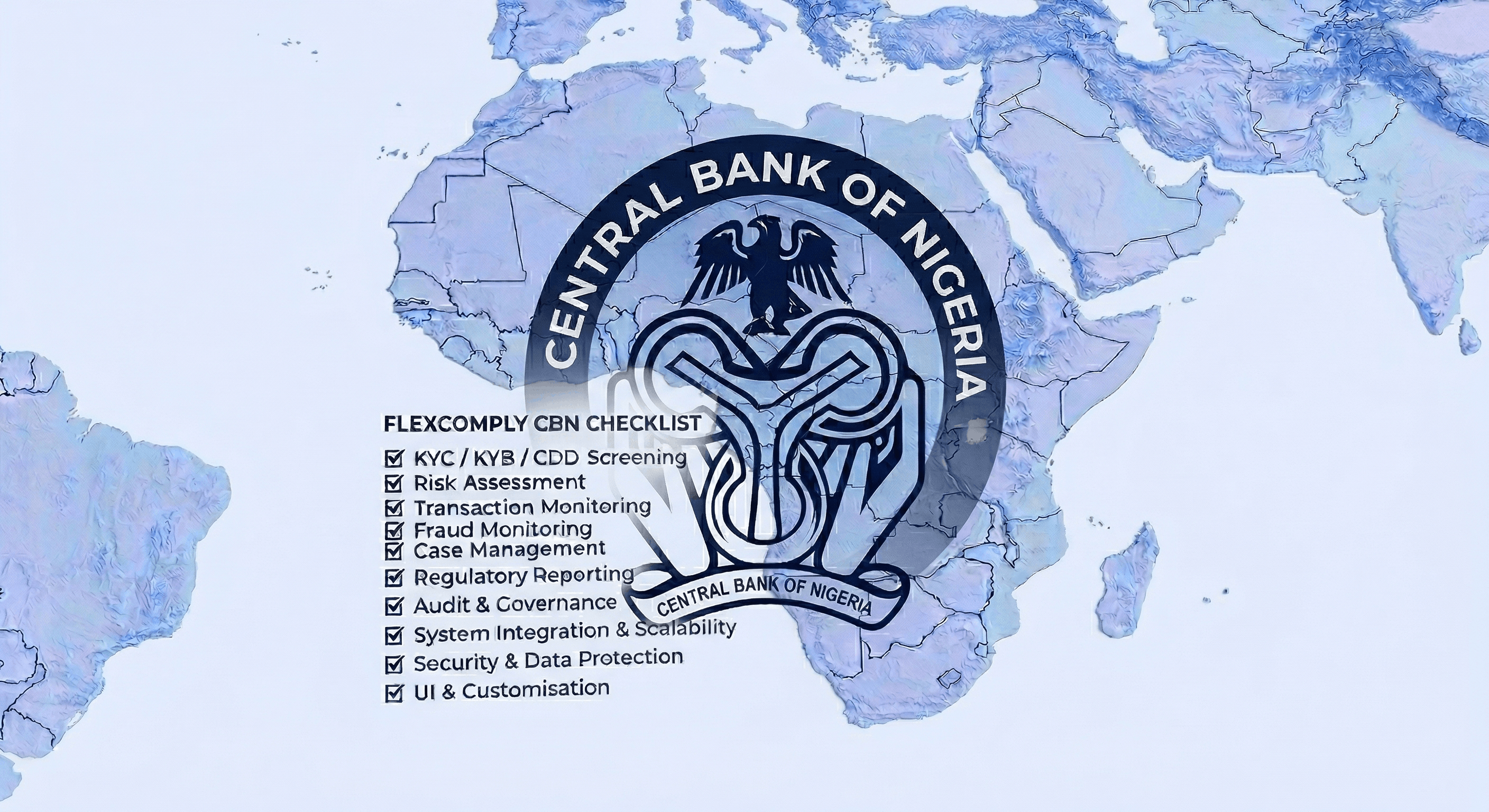
FlexM, the leading global fintech conglomerate, offers FlexComply, a 360-degree compliance technology platform designed for exactly this and beyond. As a unified FRAML platform, FlexComply addresses all 12 CBN AML requirements 2026 within a single integrated infrastructure.
Furthermore, FlexComply's AI-powered adverse media screening goes beyond keyword-based matching, using context-aware entity recognition and role-based adversity logic to deliver high-precision alerts with significantly fewer false positives. In a regulatory environment where the CBN now expects explainable AI outputs and continuous monitoring as part of its baseline standards, this capability is no longer optional.
CBN compliance 2026 is not about meeting a single deadline. It is about building the kind of financial crime compliance architecture that earns confidence from regulators, international partners and customers for years to come.
Ready to see where your institution stands against the CBN's 12 baseline requirements?
Get a tailored compliance gap analysis. No sales pitch, just expertise